Your Kubernetes Abstraction Layer Is Hurting Everyone
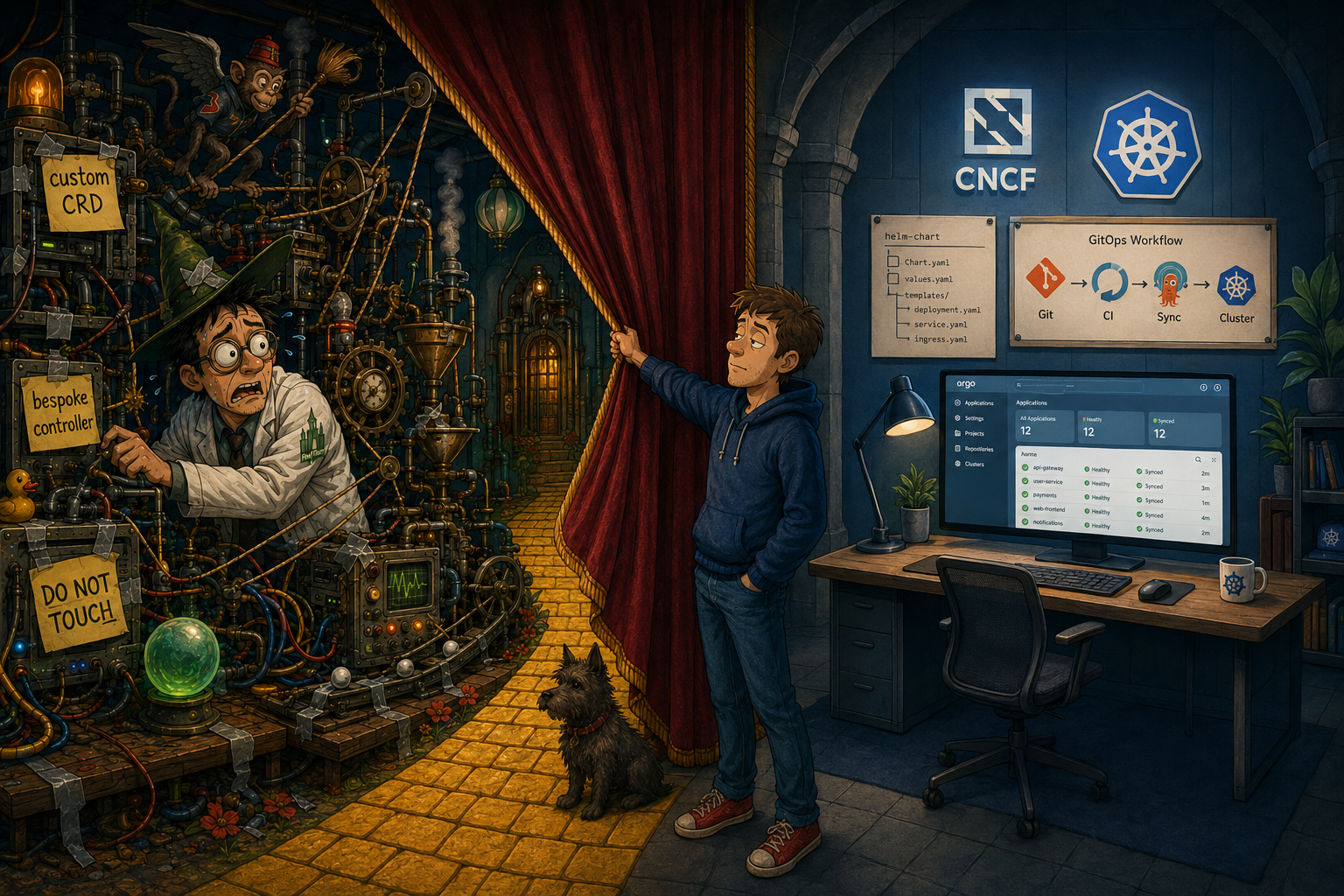
There is sometimes a pattern that shows up in large organizations running Kubernetes: a platform team builds a custom deployment pipeline, wraps it in a custom CRD, writes a custom controller to reconcile it, staffs a custom support rotation for it, and then tells developers that this is how things work here. Bring your own Helm chart or manifest? Not supported. Argo CD console access? Absolutely not, not even read-only.
The intent is good. Complex infrastructure is genuinely hard. Not every developer needs to know what a VolumeMount is. Reducing cognitive load matters.
But the execution tends to produce something that looks like platform engineering from the outside and functions like a distributed monolith with extra steps on the inside. And the thing about a distributed monolith is that it has all the failure modes of a monolith plus the operational surface area of a distributed system.
Kubernetes Has Already Won
Before making the case for developer flexibility, it is worth establishing how thoroughly Kubernetes has become the default destination for cloud workloads.
The CNCF's 2025 Annual Cloud Native Survey (released January 2026) found that 82% of container users now run Kubernetes in production - up from 66% just two years prior. Only 6% of surveyed organizations report no Kubernetes engagement at all. A joint CNCF and SlashData report published in March 2026 puts the global cloud native developer community at nearly 20 million people - roughly 39% of all software developers on earth. The technology has crossed from "widely adopted" to simply assumed.
The tooling story is equally settled. Among cloud-native practitioners: Helm sits at 81% adoption, Prometheus at 77%, and containerd at 74%. These are not experimental choices. They are the default stack.
The CNCF survey skews toward practitioners already deep in this world, so look at the broader population too. The 2025 Stack Overflow Developer Survey - with nearly 50,000 respondents across 177 countries - found that 30% of professional developers use Kubernetes and Docker has hit 73.8% adoption, its highest ever, with the largest single-year jump of any technology tracked. The container-native developer is no longer a niche persona; at nearly one in three professional developers, they are the norm.
The implication for platform teams: the developers you are trying to protect from Kubernetes complexity are increasingly people who already understand Kubernetes. They are not looking for a simpler version of it. They are looking for the real thing with reasonable guardrails.
The Abstraction Trap
Let me be specific about what a deep abstraction layer typically looks like in practice. The pattern, broadly, is this:
- A developer writes a config file with a handful of entries: image, replicas, environment. Simple.
- A custom manifest generator reads that config and produces Kubernetes resources - Deployments, Services, maybe an Ingress - based on templates the platform team controls.
- A custom CRD wraps those resources into a higher-level object that Argo CD syncs.
- Argo CD reconciles those custom resources against the cluster.
On paper, this looks clean. In reality you have introduced at least four places where something can go wrong, and the blast radius of each failure is proportional to how many teams are running through that pipeline.
When the config interpreter has a bug, it can silently produce malformed manifests. When the custom CRD has a schema drift, the controller reconciliation fails in ways that look like a Kubernetes problem, not a pipeline problem. When the Argo CD sync fails on a resource type that your team invented, the error message is not "your CustomResourceDefinition is broken" - it is something that requires the platform team to debug, because nobody outside that team knows how the magic works.
The CNCF's 2025 Annual Cloud Native Survey confirms this is real. Complexity is the fourth most-cited barrier to cloud-native adoption (34% of respondents), right behind cultural issues (47%), training gaps (36%), and security (36%). Some of that complexity is inherent to distributed systems. A measurable chunk of it is self-inflicted by organizations that built custom abstraction layers and then had to staff and support them indefinitely.
What You Are Doing to Your Platform Team
Here is the part that gets glossed over in conversations about protecting developers from complexity: building bespoke pipelines does not help the people who build them grow.
Platform engineering, done well, is a career accelerant. Working with Argo CD, cert-manager, External Secrets Operator, and Gatekeeper means building expertise that is immediately recognizable in every Kubernetes job posting in the industry, transferable across teams and organizations, and backed by a community that is constantly raising the ceiling. Every open GitHub issue, every KubeCon talk, every CNCF working group is an opportunity to learn something that makes you better at the work.
Spending two years maintaining a custom manifest generator, a custom CRD schema, and a bespoke controller loop does not produce that growth. It produces a specialist in a system that exists in exactly one place on earth - your organization's cluster. The skills are real but they cannot compound, because the ecosystem is not there. Platform engineers deserve to work on problems that make them better engineers, not custodians of infrastructure archaeology.
This is not a minor consideration. CNCF now hosts over 230 projects with more than 300,000 contributors worldwide, and the Argo project alone has contributions from hundreds of organizations. That community represents collective debugging, collective documentation, and collective improvement you simply cannot replicate with a bespoke internal tool.
What You Are Doing to Your Developers
The knowledge transfer problem is symmetric. Developers who learn to use a custom deployment pipeline learn exactly one thing: how to use that pipeline. The YAML schema your team invented, the CLI flags your manifest generator accepts, the error codes your custom CRD throws - none of it maps to anything in the broader industry. It does not prepare them for the next project, the next team, or a career that grows beyond this one platform.
That is not a side effect. It is the core product of a walled-garden platform: developers who are permanently dependent on the platform team because the skills do not exist outside the organization.
The industry is moving in exactly the opposite direction. Cloud native knowledge has become a mainstream engineering competency. According to the CNCF and SlashData, 88% of backend developers now work with at least one form of infrastructure standardization - and that figure has grown eight points in the last six months alone. Developers are learning this stack because they want to, because it is transferable, and because the tooling has become genuinely approachable.
And it has only gotten more approachable. In 2025, 84% of developers are using or planning to use AI coding tools (Stack Overflow). Writing a Helm values file, understanding a Kubernetes Deployment spec, or debugging an Argo CD sync with Claude or GitHub Copilot sitting next to you is not the harrowing experience it was in 2019. The argument that developers cannot be expected to touch YAML or read a Kubernetes manifest has aged very poorly. The floor for what a developer can accomplish with a modern AI assistant is dramatically higher than it was when most custom abstraction layers were originally designed.
Developers who want to define a blue-green rollout strategy, configure their own certificate issuance, or set a custom network policy are not asking for the moon. They are asking for what the ecosystem and their tooling already make achievable.
The Ecosystem Has the Tools
The case for giving developers direct access to Kubernetes tooling is not just a philosophical one. The CNCF ecosystem has built an extraordinarily capable set of tools that handle the hard operational problems - and they do it in ways that are documented, supported, and actively maintained by thousands of contributors worldwide.
Argo CD has crossed the majority-adoption threshold. A CNCF end-user survey published in 2025 found that nearly 60% of Kubernetes clusters managed by respondents use Argo CD for continuous delivery. 97% of those users run it in production. It carries a Net Promoter Score of 79 - in a world where NPS above 50 is considered "excellent." This is not experimental technology; 60% of Argo CD users have been running it for over two years.
Argo Rollouts brings blue-green and canary deployment strategies that would take months to build internally. cert-manager, which reached CNCF graduation in September 2024, handles TLS certificate issuance and renewal automatically across any CA. The External Secrets Operator (a CNCF incubating project) integrates with AWS Secrets Manager, HashiCorp Vault, GCP Secret Manager, and others - centralizing secret management without custom code. Gateway API has become the Kubernetes-native replacement for Ingress, offering route-level traffic control with first-class HTTPS, header manipulation, and traffic weighting that previously required ingress controller annotations and workarounds.
These are tools that millions of engineers know. They have GitHub issues, public Slack channels, Stack Overflow answers, and conference presentations at KubeCon. When something breaks, your developers can search the internet.
Guardrails Are Not the Same as Walls
The objection to giving developers direct Kubernetes access usually sounds like this: we cannot let developers do whatever they want. They will misconfigure things. They will request too many resources. They will deploy without proper security contexts.
These concerns are real. They are not solved by abstracting away Kubernetes; they are solved by policy.
OPA Gatekeeper enforces cluster-wide constraints as admission webhooks: no root containers, minimum resource requests, required labels, prohibited image registries. It is declarative, it runs at admission time (the request is rejected before anything is created), and it does not require developer cooperation. Gatekeeper is backed by every major cloud provider's Kubernetes distribution - Azure Policy for Kubernetes, Google's GKE Policy Controller, and Rancher all build on it.
Kyverno is the other major player: policies written in YAML rather than Rego, with auto-generation of Pod security policies and mutation capabilities.
RBAC scopes what resources developers can create in which namespaces. A developer deploying their application does not need cluster-admin; they need write access to Deployments, Services, and their team's ConfigMaps in their namespace.
Argo CD's project model enforces which repositories can deploy to which clusters and namespaces, what resource kinds are permitted, and which images are allowed. You can give a team their own Argo CD project with read-only visibility into the console and write access only to their applications. The "we cannot give developers Argo CD access" concern dissolves when you realize the project model was built specifically for multi-team access control.
The difference between guardrails and walls is that guardrails let you move and stop you from going off the edge. Walls stop you from moving at all. When a developer needs to do something your abstraction layer did not anticipate - a custom init container, a specific resource limit, a PodDisruptionBudget - guardrails flex. Walls produce a change request that touches half a dozen bespoke components, each owned by a different team, requiring coordination across backlogs, with someone on the hook for ensuring the change does not break the seventeen other things that run through the same pipeline.
Knowledge Debt Compounds
There is a specific kind of technical debt that accumulates in bespoke platform systems: knowledge debt. It is not code debt (code you know is bad but has not been cleaned up yet). It is structural ignorance - the organization does not actually know how something works, and finding out requires escalating to the one person who built it.
Knowledge debt is worse than code debt because it does not show up in a linter or a test suite. It shows up when that one person is on vacation and a deployment is failing and nobody can read the error message.
The more layers of custom abstraction you stack, the higher the knowledge debt. A custom config format interpreted by a custom templating service generating resources controlled by a custom CRD watched by a custom controller that feeds Argo CD - each layer is a capability that has to be implemented, debugged, documented, and supported by your team, forever, because nobody else on the planet runs this exact system.
The CNCF ecosystem inverts this. When a developer opens the Argo CD documentation, they get the same documentation that practitioners at BlackRock, Adobe, Intuit, and hundreds of other organizations have contributed to and debugged against. When they read a cert-manager GitHub issue, they are reading a thread where the maintainers, Fortune 500 engineers, and contributors from cloud providers all weighed in. The knowledge is socialized. The debugging surface is public.
Some Teams Should Not Be on Kubernetes
To be clear about the other end of the spectrum: not every workload belongs on Kubernetes, and pretending otherwise is its own kind of disservice.
If a team's actual requirement is "run my container, expose it on an HTTP endpoint," Kubernetes is probably not the right answer. The operational surface area of a Kubernetes cluster - even a managed one - is significant, and the cognitive overhead of learning resource definitions, health probes, and network policies is real if you are never going to use most of it.
AWS ECS (Elastic Container Service) and Azure Container Apps (ACA) are explicitly designed for this scenario: deploy a container image, set a port, configure a few environment variables, pay per usage. No nodes to think about. No DaemonSets. No Ingress controller. ECS is a fully managed container orchestration service that removes the control plane from your responsibility entirely; ACA layers a serverless container runtime on top of Kubernetes without exposing any Kubernetes concepts at all.
For teams that want exactly that simplicity, these platforms deliver it without compromise. The mistake is running those teams on Kubernetes and then trying to recreate the ECS experience inside it through custom wrappers. You get neither the simplicity of ECS nor the flexibility of Kubernetes - you get a franken-platform that confuses everybody.
Match the platform to the actual requirements. Teams that want to define their rollout strategy, manage their own ingress configuration, and own their delivery pipeline should be on Kubernetes with direct access to the tools the ecosystem provides. Teams that want to ship a container and forget about infrastructure should be on ECS or ACA or a similar managed service. These are not equivalent choices dressed in different clothes; they are different platforms for different problems.
What the Data Says Is Happening
The industry is moving toward more developer involvement in Kubernetes, not less. The CNCF's end-user surveys consistently show adoption of GitOps practices deepening: 93% of organizations in a recent survey of 660 software development professionals have embraced GitOps as a methodology. 83% incorporate it into their platform engineering practice. The CNCF's 2025 Annual Cloud Native Survey found that 58% of cloud-native innovators use GitOps principles extensively - the people who are furthest along in cloud-native maturity are leaning into GitOps, not abstracting away from it.
This is a community that is getting better at using Kubernetes, not looking for an exit ramp from it. The appropriate platform team response to that trajectory is investment in developer enablement - good documentation, clear golden paths, curated Helm chart libraries, Argo CD project templates, Gatekeeper constraint libraries - not a proprietary abstraction layer that requires platform team mediation for every deployment.
The organizations doing platform engineering well are providing self-service: golden paths that developers choose to follow, not corridors that developers are forced into. Research from the 2025 State of Platform Engineering found that platforms that attempt to solve 100% of developer problems at launch fail 78% of the time. The better approach is paved roads with open shoulders - defaults that make the easy case fast, without blocking the cases that do not fit the mold.
The Right Ask
The platform team's job is to make developers successful in production - not to build a system that makes developers dependent on the platform team. Those can look identical from the outside for a while. They diverge on the day a developer needs to do something the platform team did not plan for.
When that happens in a well-designed Kubernetes environment with CNCF tooling, the developer reads documentation, opens an Argo CD project setting, adds a Gatekeeper exception request, or files a PR to the Helm chart values. The system is understandable and the paths forward are clear.
When that happens in a custom abstraction layer, the developer files a ticket.
Give developers the Kubernetes they asked for. Apply policy with Gatekeeper. Control access with RBAC and Argo CD projects. Build golden paths as starting points, not as ceilings. The knowledge your developers build will transfer with them and grow with the ecosystem. The knowledge your platform team builds on industry-standard tooling will compound over time instead of aging into institutional mystery.
The Wizard of Oz routine - the enormous bespoke machine working behind the curtain - is impressive until someone pulls the curtain back. And in production, someone always eventually pulls the curtain back.
Source Links
- CNCF 2025 Annual Cloud Native Survey announcement (January 2026)
- CNCF and SlashData: Cloud Native Community Reaches Nearly 20 Million Developers (March 2026)
- CNCF End User Survey: Argo CD as Majority Adopted GitOps Solution (2025)
- Stack Overflow Developer Survey 2025: Technology
- GitOps Adoption Survey: Pace Varies Widely - DevOps.com
- State of Platform Engineering 2025 - Platform Engineering
- cert-manager CNCF Project
- Argo Project CNCF Page
Related Pages
- Parent index: Blog
- Related: Argo Rollouts Blue-Green Deployments: What Zero Downtime Actually Requires in Production
- Newsletter: This Week in Kubernetes