What Does a Kubernetes Platform Engineer Actually Do?
Published October 18, 2026 · Opinion
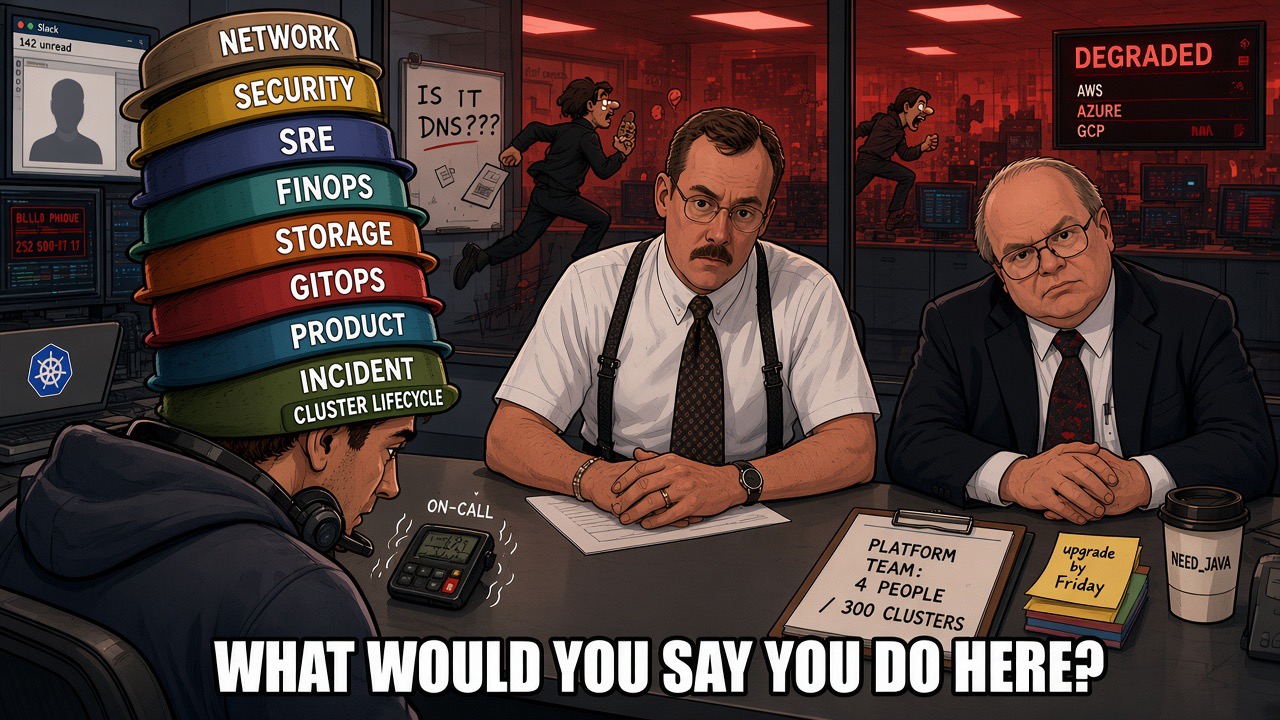
The job posting for a Kubernetes platform engineer usually has eleven bullet points and a sentence about "thriving in a fast-paced environment." The actual job, on an ordinary Tuesday with a few hundred clusters, a few thousand application teams, six regions, and two clouds, goes more like this.
You open Slack to a thread that's already forty messages deep: a team in eu-west can't reach a service, and it's DNS, except it's only DNS on one cloud, in one region, on one node image version, and only some of the time. While you're in that, security pings that a new CVE just dropped and wants to know which clusters are actually exposed, by end of day, and "by end of day" was an hour ago. Exposed depends on the node image, the runtime, the admission config, and whether the vulnerable component is even reachable, and all of that differs per cloud and per cluster, some of which were built by teams that joined through an acquisition and don't follow your conventions.
Finance wants to know why the cloud bill grew by a third. Two hours of digging later, it's a GPU node pool somebody spun up for a demo in March, and then you find three other teams who did the same thing. A minor version upgrade is due on one cloud, the other cloud's upgrade window closes Friday, and the two clouds disagree on nearly everything about how to do it.
Two teams are in a standoff over whose pods are eating a shared node pool, and both want a ruling from you. A StatefulSet in ap-southeast refuses to reattach its volume, and the team that owns it is mid-launch.
Meanwhile the design requests keep stacking up: one team is moving a stateful legacy monolith, another needs GPUs and bursty batch, a third has a latency-sensitive payment path with compliance strings attached, and every one of them wants to know how their app should run on Kubernetes.
There is no template for that. Tenancy, networking, scaling, and failure domains all depend on what the app actually does, so each one is a working session, not a link to the docs.
By six, you haven't touched the roadmap work you were actually hired to do, and tomorrow the on-call rotation hands you the pager.
That isn't a dozen different jobs. It's one job. The closest comparison I have is a city's public works department: roads, water, sewer, streetlights, snow removal, all under one roof, all invisible until something breaks. Nobody thanks public works for the water that came out of the tap this morning. Nobody thanks the platform team when the scheduler puts a pod where it belongs, either.
That invisibility is why the role gets undersold. "Manages the clusters" covers about a ninth of it. The other eight-ninths are below, along with what changes when EKS, AKS, or GKE runs the control plane (less than the marketing suggests), what happens when a company runs more than one cloud (everything gets multiplied), and why demand for people who can do this keeps climbing even as AI writes a growing share of the YAML.
One Job, Nine Hats
Cluster lifecycle. You decide how clusters get created, how many exist, and what "a cluster" even means here - per environment, per team, per region, per whoever argued loudest. Then you keep them current. Kubernetes ships a minor release roughly every four months and supports each for about a year, so the upgrade treadmill never stops: read the deprecation list, hunt down manifests using removed APIs, check every operator you've installed, upgrade the control plane, roll the nodes, and do it without anyone noticing. Teams that skip versions don't skip the work. They save it all up for one very bad weekend.
Networking. Pod networking, Services, DNS, the CNI, ingress or Gateway API, network policies, egress, and the load balancers underneath all of it. Plus IP planning, because running out of pod IPs in a VPC is a rite of passage everyone swears they'll avoid. When "the app is slow" turns out to be a conntrack table, a DNS ndots setting, or an MTU mismatch, you're usually the only person in the building who recognizes those words.
Security. RBAC, Pod Security Standards, admission policy (Kyverno, Gatekeeper, ValidatingAdmissionPolicy), secrets, image signing, supply chain scanning, runtime detection, workload identity so pods stop carrying long-lived cloud keys, and a steady stream of CVEs in a system with hundreds of moving parts. You're also the one who tells a team their container can't run as root, and you'd better be right about why.
Reliability and observability. SLOs for the platform itself, dashboards people actually open mid-incident, alerts tuned until they stop paging for things that fix themselves. Etcd latency, API server saturation, scheduler queue depth, kubelet health, node pressure. You carry the pager for the layer underneath everyone else's pager.
Capacity and cost. Requests and limits, bin-packing, HPA, VPA, Karpenter, the spot versus on-demand mix, and the monthly question of why the bill moved. Runaway Deployment, forgotten GPU pool, or cross-AZ traffic nobody budgeted for. Cost allocation by namespace is dull work. It's also what keeps the platform funded.
Storage and state. CSI drivers, StorageClasses, snapshots, backups, the gap between "the PVC is bound" and "the data is safe," and the eternal argument about whether this database belongs on Kubernetes at all. Stateless workloads forgive mistakes. Stateful ones keep receipts.
Delivery. CI handoffs, Argo CD or Flux, progressive delivery, promotion between environments, drift detection. The goal is that a developer merges a change and it reaches production by a path you built and can roll back. I wrote about where that handoff goes wrong in CI Builds It. Who Ships It?. The failure mode is a platform nobody can deploy to without filing a ticket.
Product management. This is the hat that surprises people. Your users are developers, and their tolerance for friction is finite. You decide what the paved road looks like, write the golden-path templates, curate the portal (Backstage is the usual pick), write docs people actually read, and treat "developers are routing around us" as a bug report on the platform, not a discipline problem with the developers.
Incident response and teaching. When production breaks at 2am, the platform is the first layer everyone suspects. You triage, communicate, fix, write the postmortem, and teach the org the thing it didn't know. A lot of the job is explaining Kubernetes to people who never signed up to learn Kubernetes, repeatedly, without making them feel small.
Any one of these is a full-time specialty somewhere. The platform engineer wears all nine in a single afternoon, and the problems refuse to stay in their lane. A DNS blip becomes an SLO breach that gets blamed on a deployment.
Managed Doesn't Mean Handled
The most persistent myth about EKS, AKS, and GKE is that they make the platform engineer optional. What they take off your plate is real: you don't run etcd, patch the API server, or keep the control plane highly available, and you should be grateful. Everything else is still yours. The providers call this the shared responsibility model, which loosely translates to "we run the part that's the same for everyone, and you run the part that's different for you."
What stays with you on all three:
- Upgrades. The provider offers the control plane upgrade. You decide when, test your workloads against it, and roll the data plane. Fall far enough behind and you're paying extended-support rates or getting upgraded on their schedule instead of yours.
- Nodes and capacity. Instance types, sizing, spot strategy, autoscaling, node image updates, and draining nodes without breaking anything.
- Add-ons. CoreDNS, kube-proxy, the CNI, CSI drivers, and every controller you installed, each with its own compatibility matrix and its own failure modes.
- Identity. Mapping cloud IAM to Kubernetes RBAC, and getting pods cloud permissions without baking in static keys.
- Network design. VPC or VNet layout, subnet sizing, pod IP exhaustion, private clusters, ingress, egress.
- Security posture and observability. Managed does not mean secure by default, and the provider's dashboard is not your SLO.
- Cost. The control plane is a rounding error. Nodes, load balancers, NAT gateways, cross-zone traffic, and log ingestion are the bill.
Then each provider adds its own flavor.
EKS runs on the VPC CNI's IP-per-pod model, so subnet planning matters more than people expect. Pod-level AWS access goes through IRSA or Pod Identity, and you pick between managed node groups, Karpenter, and Fargate. The AWS Load Balancer Controller has its own annotations and its own quirks, and cluster access runs through IAM access entries, which lock people out in creative ways when they're wrong.
AKS gives you a choice of Azure CNI, Azure CNI Overlay, or kubenet's legacy, and the choice shapes your IP and scale story. Identity runs through Entra Workload ID. Auto-upgrade channels and a separate node image channel interact in ways you design deliberately or discover painfully.
GKE starts with a fork: Autopilot, where Google manages the nodes and bills per pod request, or Standard, where you manage node pools. That one decision changes your whole operating model. Release channels, maintenance windows, Workload Identity Federation, and Dataplane V2 (Cilium underneath) fill in the rest. GKE removes more work than the other two when you let it, and in exchange asks you to live inside its opinions.
The pattern holds across all three. The provider owns the part of Kubernetes that's the same everywhere. You own the integration between Kubernetes and the provider's identity, networking, storage, and billing, which is exactly the part that's different everywhere. As I wrote in my multi-cloud piece, a Deployment is portable. The IAM, the load balancer annotations, and the storage classes are not. The expertise that lives in that gap is the job.
Now Do It Three Times
Everything above assumes one provider. Plenty of companies don't get that luxury, whether it's an acquisition, a regulator, a big customer's requirements, or a deliberate multi-cloud strategy. In those companies the hats don't add up. They multiply, because every hat now gets worn once per cloud, and then once more for whatever ties the clouds together.
- Identity is three models (IRSA or Pod Identity, Entra Workload ID, Workload Identity Federation) with three failure modes, and you still owe the org one coherent access story.
- Networking is three CNI behaviors, three load balancer integrations with three annotation dialects, and then the cross-cloud part: connectivity, DNS, egress costs, maybe a mesh.
- Upgrades are three version calendars and three support policies. The same upstream API removal lands in different clusters on different dates, and you track every one.
- Security and compliance are three posture tools, three audit log formats, and one auditor who wants a single answer.
- Observability and cost are three native stacks and three billing models. A single pane of glass across them isn't something you buy. It's something you build and then own.
- On-call means the person paged at 2am has to know which cloud's quirk they're staring at, and that only comes from having been burned by it before.
On top of that sits the abstraction layer: Terraform or Crossplane, Cluster API, fleet management, GitOps tooling that spans every cluster. That layer is its own product, with its own bugs and its own roadmap, and somebody on the platform team owns it.
This is the real cost of multi-cloud, and it almost never makes it into the architecture review. Nobody is an expert in all three providers at once, so the people who can reason about the common model (Kubernetes) while knowing precisely where each provider diverges are scarce. It's also why I keep arguing most organizations shouldn't go multi-cloud casually. If yours already has, this is the bill.
The Demand Isn't Subtle
A caution first. Job-posting data on the public web mostly comes from aggregators and training vendors, who have a commercial interest in the story, so I'm going to be specific about what each number does and doesn't measure.
The CNCF's 2025 Annual Cloud Native Survey, published in January 2026, found that 82% of container users now run Kubernetes in production. It also found 98% of surveyed organizations have adopted cloud native techniques, and 59% say much or nearly all of their development and deployment is now cloud native. That's a survey of container users, so it measures Kubernetes share among people already running containers, not among every company on earth. Within that group, it's essentially the default.
On the hiring side, a CertDemand analysis of Adzuna posting data found weekly US postings naming the CKA rose from 228 to 758 between January and July 2026, up 232%, while Terraform Associate postings rose 135%. Read that one carefully: it only counts postings that name a certification, so it understates demand for the underlying skill, and it covers six months. It's a signal, not a census.
And the people side lines up. The Linux Foundation's Kubernetes Turns 10 report from October 2024 listed the learning curve (59%), security (44%), and talent shortage (36%) as the top challenges, with 76% of organizations planning to expand their adoption. Hard to learn, hard to secure, hard to hire for, and growing. That's a market where experienced people have leverage.
So Is AI Coming for It?
The reasonable worry: if AI can write Terraform, generate manifests, and decode a stack trace, doesn't it eat the job?
I'd be suspicious of anyone who calls a job "AI-proof," so I won't. What I can do is look at where AI workloads actually run, and what the research says about who benefits.
They run on Kubernetes. The same CNCF survey found that 66% of organizations hosting generative AI models use Kubernetes for some or all of their inference. Meanwhile 44% don't yet run AI/ML on Kubernetes at all, and only 7% deploy models daily, so the infrastructure is well ahead of the practice. There's a long runway. The CNCF's Kubernetes AI Conformance program grew from 18 to 31 certified platforms within a few months, with new requirements covering agentic workflows and in-place pod resizing for inference.
And AI workloads are more platform work, not less. GPU scheduling, device plugins and Dynamic Resource Allocation, queueing and gang scheduling for batch jobs, node pool strategy for the scarcest and most expensive hardware you'll ever rent, model artifact distribution, cost control on top of all of it. That's new surface area stacked on the old surface area. Nobody retired the networking and security hats to make room.
The 2025 DORA report, built on responses from nearly 5,000 technology professionals, found that the greatest return on AI comes not from the tools themselves but from the quality of internal platforms, the clarity of workflows, and the alignment of teams. Put plainly, AI amplifies whatever system it's dropped into. A shaky delivery platform plus AI gets you more shaky deployments, faster. Someone has to own the system that decides whether AI-generated changes ship safely, and that someone is the platform team.
So where does it stop? I'm not claiming a permanent boundary, but these hold up today:
- Deciding what an agent is allowed to do. An agent with cluster access is a new principal in your security model. Its RBAC scope, which actions need a human's approval, its blast radius when it's wrong, and its audit trail are all design decisions, and a person makes them.
- Verification against ground truth. Models are confidently wrong when they have partial context, and in a shared control plane a wrong change doesn't stay small. Dry-runs, policy checks, staged rollouts, and tested rollback paths have to exist before anything fast gets near production. Building them is platform work.
- Context that lives outside the cluster. Whether a risky upgrade can wait depends on the sales freeze, the contractual window, which team is already stretched, and how much risk the business will tolerate this quarter. Plenty of that is written down nowhere an agent can read.
- Architecture under organizational constraints. Cluster topology, tenancy, build versus buy, and which tradeoff to take when the technically clean answer is politically impossible.
The Engineer Who Runs the Agents
Here's the part I find more interesting than the replacement question. The engineers pulling ahead right now are not the ones asking a chatbot for a manifest and then going back and forth to fix what it got wrong. That's autocomplete with extra steps. They're orchestrating: treating AI like a team of fast, tireless, context-free juniors, and building the system around them that makes the output trustworthy.
In practice that means giving agents real context - the repos, the runbooks, your written standards, scoped read-only cluster access, and instruction files that encode how your org does things, so every run starts from your conventions instead of the model's defaults. It means decomposing the work. A fleet-wide upgrade-readiness pass is a good example: one agent scans every cluster for removed APIs, another checks each installed operator against its compatibility matrix, a third drafts the fix PRs, all in parallel, all landing as diffs you can review. It means wiring agent output through the same CI, policy-as-code, dry-runs, and staged rollouts as human output, with failed checks feeding back automatically so the loop closes without you relaying error messages. And it means reviewing at the right altitude. You read the plan and the diff. You don't babysit every step.
Systems knowledge is what makes any of that work. You can't decompose a task across a system you don't understand. You can't tell which gate is missing, or notice that an answer is plausible and wrong. Two engineers can use the same model and get wildly different results: the one who understands how the CNI, the IAM, the admission policy, and the autoscaler interact hands an agent a well-scoped problem and can verify what comes back, and the one who doesn't can only ask and hope. DORA's finding is the same idea at organizational scale. AI amplifies the system underneath it, and it amplifies the engineer the same way.
The engineers most at risk are the ones who only ever did the typing. The ones best positioned understand the whole system, from the DNS record to the GPU, and can direct AI across all of it. That job is changing shape, with less hand-typing and more architecture, guardrails, and orchestration. It isn't going away, and for anyone who has spent years learning how all these pieces actually connect, the leverage has never been higher.
Source Links
- CNCF Annual Cloud Native Survey 2025 announcement (January 20, 2026) - 82% production use, 98% cloud native adoption, 66% of generative AI hosts using Kubernetes for inference, 44% not yet running AI/ML on Kubernetes, 7% deploying models daily
- CNCF: The future of AI is community driven and open (July 23, 2026) - AI Conformance program growth from 18 to 31 certified platforms
- CertDemand: The Certification Job Market, H1 2026 - CKA +232%, Terraform Associate +135%, Adzuna API methodology
- Linux Foundation Research: Kubernetes Turns 10 (October 2024) - top challenges and adoption plans
- Announcing the 2025 DORA Report (Google Cloud) - AI returns tied to internal platform quality
- Kubernetes: Release cycle and version support - cadence and support window
- Amazon EKS: IAM roles for service accounts
- AKS: Supported Kubernetes versions
- GKE: Release channels
Related Pages
- Parent index: Blog
- Related: Multi-Cloud Kubernetes: The Honest Take
- Related: CI Builds It. Who Ships It?